Back when I was pregnant I once said that our child will be Serbish. Makes sense, right? 50% of Serbian genes would come from me and 50% of English genes from my husband. However, I didn’t have only genes in mind when I said Serbish.
Siberia
We currently live in the UK, but I would like our child to have clear awareness that 50% of who she is comes from that country in East, or is it South-East, Europe?
That country that starts with letter ’S’.
Serbia.
Is it cold over there?
No, not Siberia, SERBIA!
Not quite prepared
Jokes from real life aside, I always knew I would speak to my Serbish child in my mother tongue. Likewise, I always knew it would make me extremely happy if she was bilingual. But, to be 100% honest with you, I have read ZERO books on how to raise a bilingual child.
Natural, but not easy
We have approached ‘two languages in the house’ as the most natural and normal phenomenon and we are still to find out if it will be fruitful. I am conscious, however, that in our case there are three factors that could make Serbian language acquisition slower for her:
- We live in the country where English is spoken, so her schooling will all be done in English;
- Husband and I speak English between us;
- The structure of English language is simpler than that of Serbian.
The power of simple words
I don’t think the first two points need to be discussed further, but I want to touch upon English vs Serbian. On the word level, take for example: ‘ball’ vs ‘lopta’; ‘dog’ vs ‘kuca’, and ‘duck’ vs ‘patka’. She has been saying ‘bo’ when she sees a ball, ‘do’ when she sees a dog and ‘da’ when she sees a duck, leaving her mother in the state of absolute jealousy I must admit. How is it possible she says ‘da’ for a duck, when she hears the word ‘patka’ from me at least 50 times a day? Having said that I am aware that if I was given the same choice, I would probably also go for the monosyllabic word of the two.
Good luck with the Serbian when cases and other complicated bits of the language get involved!
Where we currently stand
They say bilingual children start talking later. This may be happening to us. Klara is 18 months old and apart from the constant chatter in her own language, ‘Mama’ is the only word she says. Her ‘Mama’ sometimes really means ‘Mama’ but it can also mean ‘Klara’ or even ‘Tata’. I very often dread to think what kind of chaos is in her head, especially when the three of us are together, we see a duck (as we do daily!), and then she hears the word ‘duck’ from one parent and half a second later ‘patka’ from the other one.
To be fair to her, she understands both languages: Animals, food, daily routine chat & instructions – understanding is there and I cannot help but be proud of her.
Current exposure
Below is a list of things and activities that I have found helpful in terms of bringing Serbian closer to my child:
- I speak to her in Serbian only;
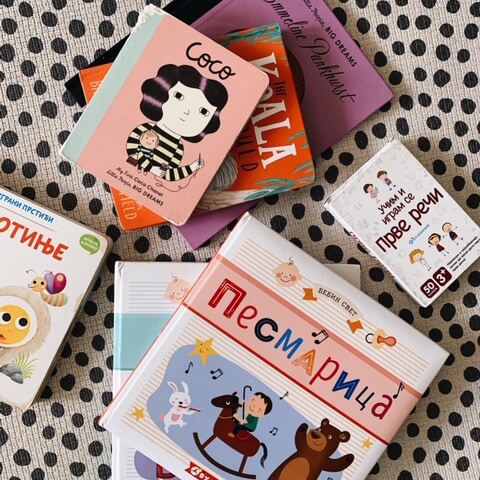
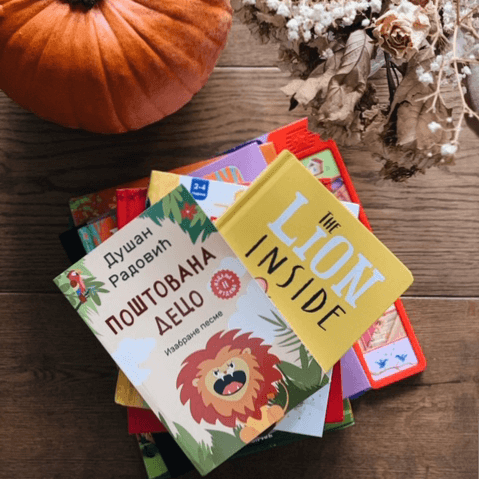
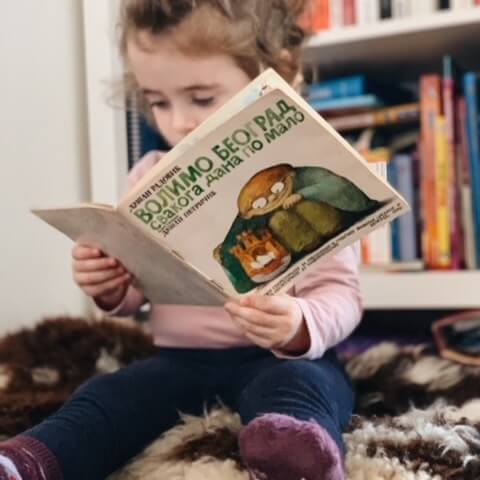
- Her library section has a lot of books in Serbian. Currently the one she loves is a collection of Serbian childhood poems. She loves when I read/sing these to her and we are now at the stage where she just points to the song in the book expecting me to start singing immediately like a jukebox – and that is exactly what I do.
- We play a lot with flashcards.
- We regularly video chat with my family on WhatsApp.
- We play children songs in Serbian, although I just discovered how useful the following songs are for learning about some vehicles: Avionu slomiću ti krila and Amsterdam (Neko mi je ukrao biciklo)*.
- If we are ‘reading’ an English book, I translate and read it aloud to her in Serbian.
I do not know if any of these activities will make her bilingual or a confident Serbian speaker. Time will tell. The best thing we can do is surround her with love, happiness and put no pressure on her with regards to what language(s) she will speak.
That needs to come from her heart.
_________
*Avionu slomiću ti krila and Amsterdam are famous songs by a Serbian/Yugoslav band Riblja Čorba. These are, by no means, children songs.